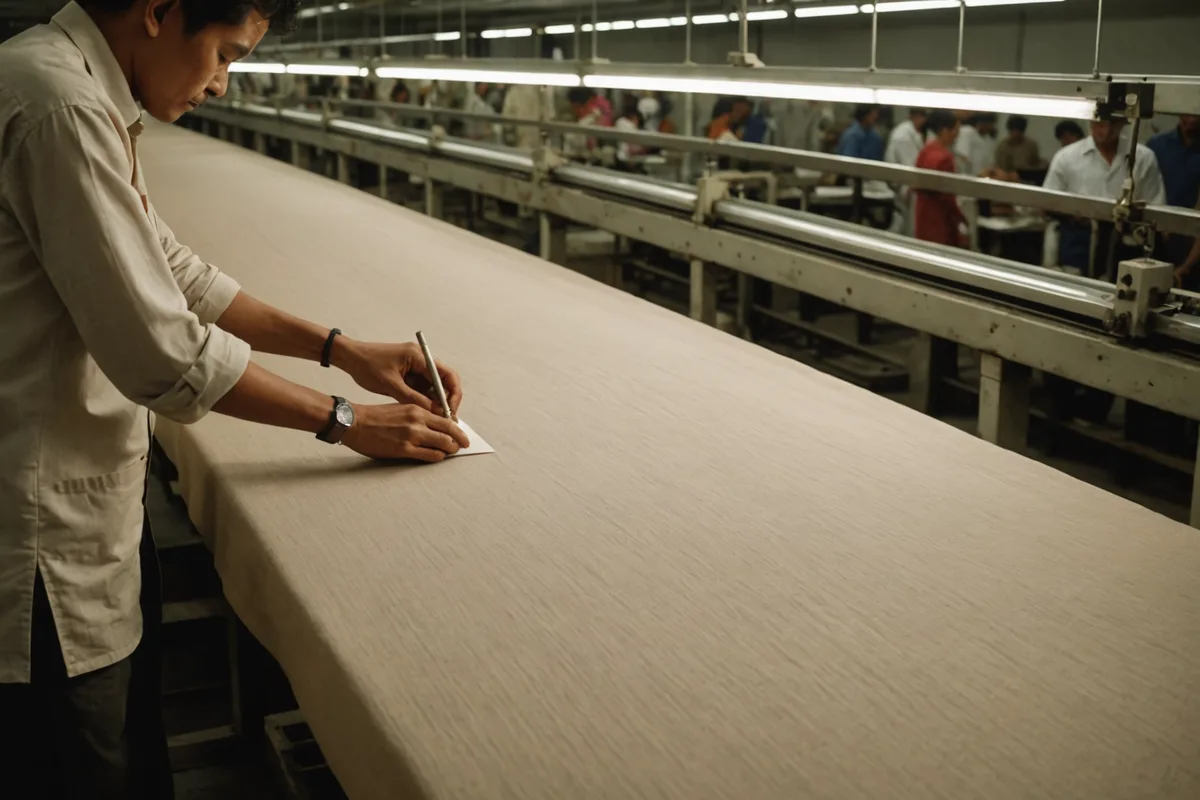
A production calendar can show scheduling habits and capacity pressure that a factory visit cannot: a visit captures one moment, while the calendar records how the factory distributes work, absorbs constraints, and handles competing orders over time.
For a brand production manager, the calendar may arrive as a shared spreadsheet with booked order slots by week, committed cut dates, expected sew complete dates, QC dates, and open capacity windows. It can look like an administrative document. Read systematically, it becomes a record of operating behavior.
1. Look at how far ahead the factory is booked
Start with the available capacity windows. A factory with open slots next week but no space for the following two months is operating differently from one with capacity spread evenly across the quarter.
A calendar that is fully booked eight or more weeks out usually indicates a capacity constrained operation. That is not automatically a problem. It may reflect strong demand, a stable customer base, or a factory that plans carefully. The important question is whether the factory has left room for normal changes, such as revised quantities, replacement materials, or a delayed approval.
Check whether the booked work is concentrated in a few weeks or distributed across the period. Look for repeated movement of orders into the next available slot. If a factory keeps adding new orders to a calendar that already has no visible buffer, its dates may be based on hope rather than available labor and equipment.
Also compare the calendar version dates. A plan that is regularly rewritten can still be useful, but the changes should have a clear reason. A factory that changes dates without preserving the original plan makes it difficult to distinguish a genuine production delay from a revised promise.
2. Count concurrent sewing orders
Next, count how many orders are active in sewing during each week. This is one of the clearest indicators of how much competition exists for shared resources.
A factory running eight or more concurrent sewing orders may have strong throughput. It may also be creating a queue for finishing and QC. Sewing lines can continue producing while downstream teams wait for inspection capacity. When that happens, several orders appear nearly complete but remain stuck before shipment.
Do not read the order count in isolation. A factory may have ten small orders in sewing and still carry less work than a factory running three complex orders. If the calendar includes quantities, compare total units and garment complexity. If it does not, ask how many lines, operators, and QC stations are assigned to each order type.
Pay close attention to whether QC dates are spread across the week or grouped at the end of it. A cluster of QC dates may indicate that the factory treats inspection as a final administrative step instead of planning it as a production activity. That pattern is important because late orders often accumulate at QC even when cutting and sewing appear on schedule.
3. Test the spacing between milestones
A calendar should show more than dates. It should show enough time between dates for the work to happen.
For a 1,000 unit woven garment order, a reasonable starting reference is three to five days from fabric receiving to cut complete. Cut to sew complete typically takes 10 to 18 days, depending on construction and complexity. Sewing to finishing may take another three to five days, followed by two to three days for QC.
These are not universal deadlines. A simple repeat style may move faster, while a detailed garment with multiple operations may take longer. The value of the ranges is that they give you a basis for questions.
- Does the cut date allow time to check fabric quantity, shade, and defects?
- Does the sewing window match the order quantity and garment construction?
- Is finishing scheduled before the QC team is expected to inspect the goods?
- Does the plan include time to rework failed pieces?
Three days between cut complete and sew complete could be realistic for a very small order. For a 1,000 unit order, it needs an explanation. It may mean the order is being split across lines, or it may mean the dates were compressed to meet a requested delivery date without confirming the underlying work content.
4. Check the calendar against real holidays
Holiday patterns are a useful test of whether the calendar reflects the factory's actual environment. Indonesian factories typically show reduced capacity around Lebaran, or Eid al-Fitr, Eid al-Adha, and national holidays. The length and timing of the reduction vary, but the constraint itself should be visible.
A calendar with unchanged capacity through a major holiday window is not necessarily proof of a problem. The factory may have a specific staffing arrangement, or the work may be scheduled before the holiday. But it should be able to explain why the calendar shows no reduction.
Look for three things:
- A visible drop in available capacity during the holiday period.
- Orders with earlier cut dates or later delivery dates around that period.
- Buffer after the holiday for staff return, line restart, and accumulated work.
The buffer matters. A factory may reopen on a stated date, but not return immediately to normal output. If every order resumes at full capacity on the first working day after a long closure, the calendar may be ignoring restart friction.
5. Compare a healthy calendar with a compressed one
Consider two synthetic calendars for similar 1,000 unit woven garment orders.
The first calendar shows fabric receiving on Monday, cut complete by Friday, sewing across the next two weeks, finishing over four days, and QC across three days. There is a small gap before the planned shipment, and the order does not overlap with an excessive number of other QC events. The calendar also reduces capacity around Lebaran and moves later orders accordingly.
The second calendar shows fabric receiving on Monday, cut complete on Tuesday, sew complete three days later, finishing in two days, and QC on the following day. Four other orders reach QC in the same week. The factory is booked continuously for the next eight weeks, with no visible holiday reduction or recovery buffer.
The first plan is not a guarantee. It may still encounter fabric defects, absenteeism, machine breakdowns, or approval delays. However, its spacing gives those risks a place in the schedule. The second plan may be possible for a very simple product with dedicated resources, but without that explanation it is a compressed plan. It depends on every preceding activity happening without delay and on downstream teams absorbing several orders at once.
This is the boundary to keep in mind: a production calendar is a plan, not a commitment. The pattern of how a factory builds its plans still reveals a great deal about its execution discipline. A factory that consistently includes realistic buffers, holiday constraints, and QC capacity is showing a different planning habit from one that places every milestone at the earliest possible date.
What the calendar cannot tell you
A calendar is not a complete factory assessment. It cannot tell you whether the quality standard is appropriate, whether operators are retained from order to order, or whether the factory will subcontract part of the work. It also cannot prove that the reported dates describe work happening inside the named facility.
Those questions require other evidence, including quality records, production communication, audit information, and clear disclosure of subcontracting arrangements. A well spaced calendar can still belong to a factory with quality problems. A crowded calendar can still be managed well if the factory has the staffing and controls to support it.
The strongest reading comes from comparing planned dates with checkpoint events over time. SPUN aggregates event data from factory reporting so that repeated production cycles can show the factory's actual cadence: which milestones slip, how long QC queues remain open, and whether the same bottleneck appears across orders. That record can be more informative than a one time factory visit because it reflects repeated execution rather than a single observed shift.
Once you can read the calendar, a negotiation changes from asking only for an earlier delivery date to asking which capacity window supports it, how many orders will share QC that week, and where the recovery buffer sits. If the factory cannot point to those details in its own plan, the delivery date is a request, not a schedule.